
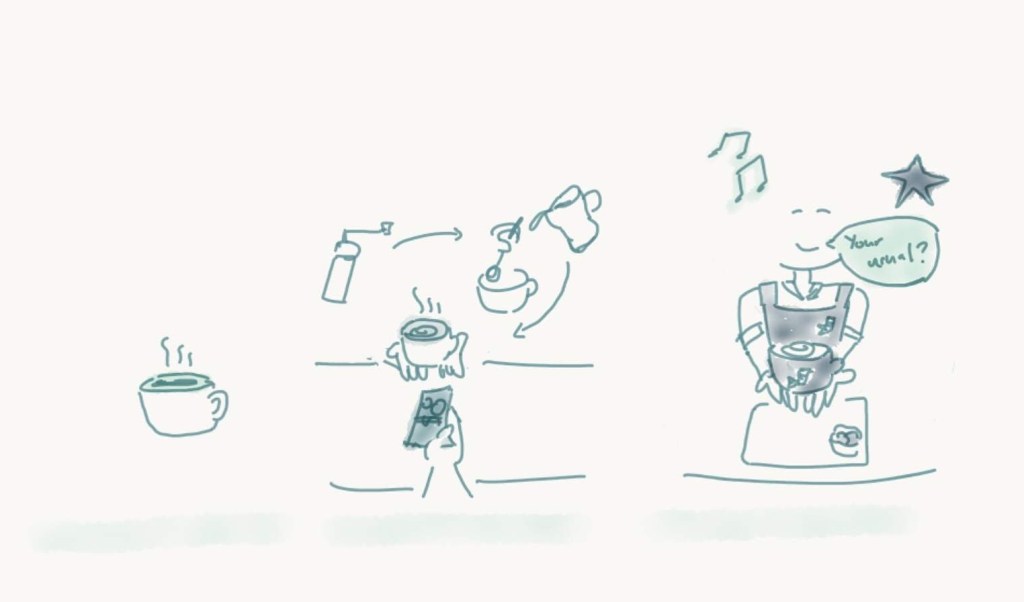
Originally written in December 2023, and posted on Notion.
What do I even think of Service Design now?
>8 years ago, my dream was to do service design. Then, I got to actually do it. I don’t think I was great at it, that time.
I still love it, but I needed a lot of complementary skills to excel at it.
Sidenote: When I was 16, I really wanted to be in advertising – as a strategic planner.
When I was 32, I actually became a strategic planner, in one of the largest, most established ad agencies in the world. After 2 months of finally getting to try it…I realized I didn’t actually want to do it as a job.
People change. Our values change. Our hobbies change. The world changes, too.
I’ve been out of service design for over a year, and I realized that I had gotten so focused on interface-related UX work lately, that I haven’t given service design much thought in all this time.
So, with fresh but experienced eyes, what have I learned, and what do I think now?
- It is tough.
I would now be doubly wary about taking a service design role, even if I feel very experienced in it. I salute people working in government, traditional (non-tech) financial institutions, and other legacy corporations delivering services.
When I had the ambition of being a service designer, I was a self-confident UX leader wanting to challenge myself with ever-increasing complexity. I would often find myself saying that I want to push myself to excel at new things. And, maybe something finally beat me haha. - What makes it tough: scale and sovereignty.
People are individuals with free choice and personal values, and corporations are groups of individuals. A 12,000-person company is 12,000 personal values and levels of learning that you’re trying to steer.
Let me unpack these further — WITHOUT reading any new blog posts or videos on Service Design, first.
What I would do (differently), given what I know now:
Or “What I would do on my next round of trying it”:
- Assemble a multi-discipline team.
Service Design isn’t UX design, and shouldn’t be comprised of primarily tech people. - Half of the work is people: operations, communication and human resources.
So whether through cross-department teamwork, or hiring: I’d make sure I represent people roles in the working team.
If there’s just one dedicated workstream, then maybe they can be champions from other departments you work with, but you definitely need to have people thinking through:
– training and onboarding
– incentives
– operational efficiency and implementation
Service design is the design of behavior, but not in the way that UX is.
Full disclosure, this actually resulted in a lot of insecurity on my part, because I had realized this difference a bit late in the game. - The trickiest thing – will be navigating management decisions.
Of course, the extent of this depends on the organization, blah blah blah.
But — whether in a huge conglomerate or within a team of 40 — Collaborating for process improvement typically spans departments, and therefore, command/ control lines. And, I’m not saying this is due to politics or nefarious reasons (people being irrationally difficult).
Teams normally have differing priorities. That’s just the truth. And, since they have different priorities – you have to be super convincing, or super… you know what, super convincing.
Then, I guess there are just different ways of being convincing – fear, charisma, tangible incentives, user experience improvement – however way you get there. - Early/From the get-go: Discover and manage ways-of-working for leadership decisions.
And that differs per case/organization. Some leaders want to fly incognito in organizations that have a high need for buy-in. For good reason. But, you need to know that and build a repeatable process for it.
[Break]
I’m old school. I have this mood where I don’t want my writing touched by AI, even from a proofreading standpoint. I bet there’ll be scenarios where it’ll be cool to feed it and say “hey, please see how this can be worded differently, and concisely”. But, now is not that time.
I’m going old-school for this.
Let’s continue.
5. I would have gotten training in:
a. Actionable communication
Knowing what I know now – my writing style was borne out of my being a qualitative researcher and my childhood dream as an opinion columnist. → The complete opposite of what an organization would need for change management.
b. Operations management
Service design is… half-operations. It is about the efficiency of human processes. Which, although related to User Experience Design – is also not the same thing.
Buttons don’t need to be motivated or trained to guide people through something.
Wonky interfaces can be debugged with rewritten code.
With humans, especially in complex organizations, the action <> outcome connection is not as direct.
c. Program management
Service design consists of weaving multiple sub-initiatives, done by already-busy departments. Experience in operationsXprogram management would help in a concrete or technical sense to make sure that the initiatives roll out.
And, all of these led to what I’m studying now (Shout-out to BCIT’s Information Technology Management program).
Next week: Articles that helped me implement service design better, this time ‘round.
 ao
ao 
Leave a comment